Competitions
How football competitions work
Club football is built from domestic leagues and cups into continental and intercontinental competitions. International football is separate, with national teams qualifying for continental tournaments and the World Cup. This guide explains the main competition formats, how club and international football are organised, and how teams qualify from one competition to another.
What a football competition is
Almost every football match is part of a wider competition with a defined start, end and winners.
A football competition is any tournament or series of matches with a clear structure and a clear way of deciding the winners. Most are built from one of three basic formats — leagues, cups and tournaments — and many combine them. Each format rewards a different mix of consistency and one-off performance, and the same shapes appear right across the game, from a small regional league to the World Cup.
In addition to format, competitions are shaped by who takes part — clubs or national teams — and by their level, from domestic competitions within one country to continental and global competitions. The sections below cover the three main formats first, then the main groups that competitions fall into, and finally the calendar and the qualifying links that tie them together.
Leagues
A league is a long competition decided across a season, with every team playing every other team.
In a league, every team plays every other team across the season, usually twice — once at home and once away. Points are awarded after each match: three for a win, one for a draw, none for a defeat. At the end of the season the team finishing top of the table win the league. Because positions are decided across thirty or more matches, the format rewards consistency above anything else.
Most leagues sit inside a pyramid. Lower divisions feed into higher ones each season through promotion and relegation — the top teams of one division move up, the bottom teams of the division above move down. The exact numbers vary by country. Many countries also use end-of-season play-offs to decide one or more of the promotion places, giving teams that just missed automatic promotion a second route up.
Cups
A cup is a knockout competition where a single defeat ends a team's run.
In a cup, teams are paired in a draw and the winners of each tie progress to the next round while the losers are out. A single defeat ends a team's involvement, which makes the format unpredictable — a smaller club can knock out a much bigger one on a good day.
Some cup ties are decided in a single match, with extra time and a penalty shoot-out if scores are level after 90 minutes. Others are played over two legs, one at each team's home ground, with the team scoring more goals across both legs going through. Domestic cups usually use single-match ties, especially in the later rounds. Continental club competitions often use two-legged knockout ties before the final, while major international tournament finals usually use single-match knockout rounds.
Common features of a cup
A few features come up again and again across the different cup competitions.
Single-match knockouts
One match decides the tie. If scores are level after 90 minutes, the match goes to extra time and then a penalty shoot-out. Many domestic cups now settle ties in this way rather than using replays.
Two-legged ties
The tie is played across two matches, one at each team's home ground. The team with more goals across both legs go through. If aggregate scores are level, many competitions use extra time and penalties to settle it.
Exemptions, byes and seeding
Stronger teams are often exempt from the early rounds, joining a cup at a later stage rather than entering at the start. A bye is different — it is when a team advances to the next round without playing, usually because of an uneven number of entrants. Seeding rules can also be used to keep the strongest teams apart in the early rounds so the later stages are more competitive.
Replays
Some cup competitions replay drawn ties at the other team's ground instead of going straight to extra time. The FA Cup used replays for many decades, but its main rounds are now settled on the day.
Tournaments
A tournament combines a group stage with a knockout stage, and is the usual shape for the biggest events in the game.
A tournament is a self-contained competition, usually played within a few weeks, that brings the two basic formats of league and cup together. It begins with a group stage — teams are placed into small groups and play each other, with the top finishers in each group going through — and ends with a single-match knockout stage, using extra time and penalties where needed. This mix rewards both early consistency and the nerve to win one-off matches in the later rounds.
The format is most associated with international football. The World Cup, the Euros and Copa América all follow this basic shape, varying in the number of teams, the number of groups and how many progress from each.
The same broad shape runs through the club game. Intercontinental competitions such as the FIFA Club World Cup use it as a self-contained tournament, much like the international events, while continental club competitions use a similar shape spread across a season rather than a few weeks. The Copa Libertadores still pairs small groups with a two-legged knockout, whereas UEFA's competitions, including the Champions League, have replaced those groups with a single large league phase before the knockout stage.
How football competitions are organised
Above the individual formats, the competitions are grouped into the international game and the club game, with the club game running in layers.
The global game is organised under FIFA, six continental confederations and the national associations beneath them. FIFA sits at the top of the international game, while the confederations and associations organise most of the competitions below it. The six confederations are UEFA in Europe, CONMEBOL in South America, CAF in Africa, AFC in Asia, CONCACAF in North America, Central America and the Caribbean, and OFC in Oceania.
At the broadest level, football's competitions split into two halves — the international game, played between national teams, and the club game, played between clubs. The club game then runs in three layers. Domestic football is the everyday level, the leagues and cups played within a single country. Continental football is the level above it, where the strongest clubs of a confederation meet. Intercontinental football is the level above that again, where leading clubs from different confederations come together for a global title.
The women's game follows the same broad pattern, with international tournaments, continental club competitions, and domestic leagues and cups.
The main groups of football competition
Each group has its own guide, covering the competitions within it and how they fit together.
International football
National-team football, played between countries rather than clubs. It is built around the World Cup and each confederation's leading tournament, such as the Euros, Copa América and the Africa Cup of Nations.
Read about international footballDomestic football
The everyday level of the club game — the leagues and cups played within a single country, from the Premier League and La Liga to the Brasileirão and Major League Soccer.
Read about domestic footballContinental club football
The level above the domestic game, where the strongest clubs of a confederation meet — the Champions League and Europa League in Europe, the Copa Libertadores in South America, and their equivalents across the other confederations.
Read about continental club footballIntercontinental club football
The global level of the club game, where leading clubs from different confederations meet in competitions such as the FIFA Club World Cup and the FIFA Intercontinental Cup.
Read about intercontinental club footballWomen's football competitions
The women's game across the same layers as the men's — the Women's World Cup, the UEFA Women's Champions League, and domestic leagues such as the WSL in England and the NWSL in the United States.
Read about women's football competitionsThe football calendar
The football year is shaped around the domestic season, with international football fitted around it.
In most of Europe, the domestic season runs from August to May, with a winter break of varying length and matches concentrated at weekends. In other parts of the world the calendar can be different — the Brasileirão in Brazil and the Scandinavian leagues both run roughly across the calendar year, so their seasons line up with the European summer rather than against it.
Inside the season, FIFA sets out international windows — short blocks of time during the year when national teams can call up players for matches. Major domestic leagues pause for these windows, which are used for qualifiers, friendlies and competitions such as the UEFA Nations League. This is how national teams keep playing between the major tournaments.
Between one domestic season and the next, clubs play friendly matches and short pre-season tournaments to prepare for the new campaign, and the biggest international tournaments often run through this gap. The World Cup, the Euros and Copa América are usually associated with June and July, while tournaments such as the Africa Cup of Nations and the Asian Cup have often been played at other times of year.
How teams qualify between competitions
Football competitions are linked. How teams perform in one usually decides whether they appear in another.
A successful league season can earn a club a place in continental competition the following year. A relegation can drop a club out of the top division entirely. Winning a domestic cup often earns a continental place as well, which is one reason the major cups remain prestigious, particularly for clubs lower down the league table.
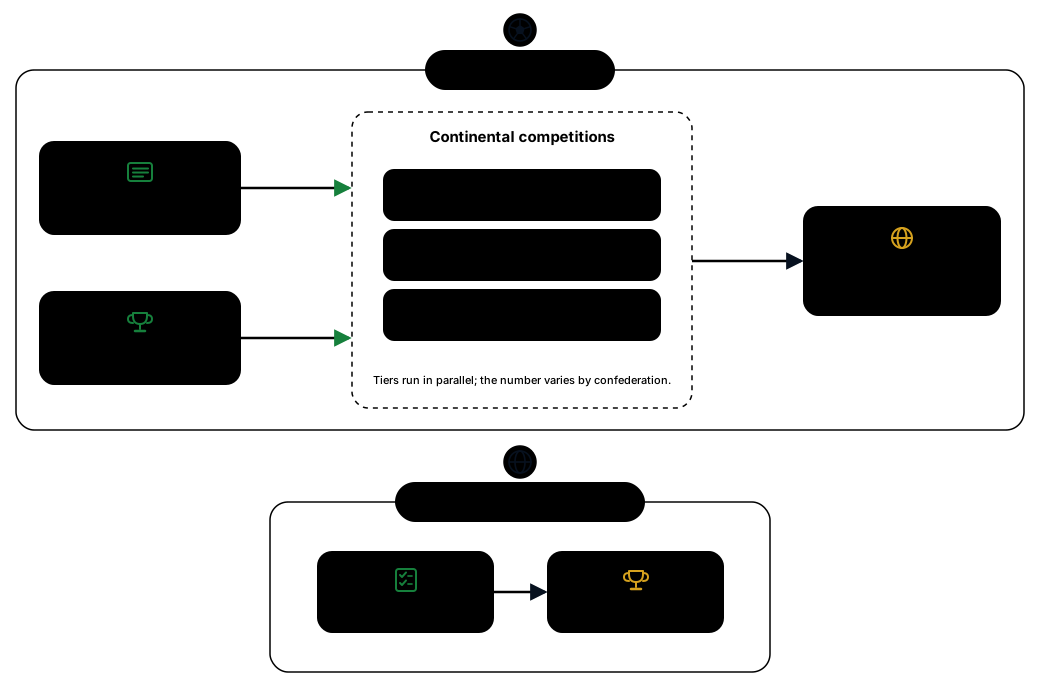
At the top of the club game, the chain usually runs from domestic competitions into continental competitions, with the best continental performers then qualifying for the intercontinental FIFA tournaments. The exact route depends on the competition: some places go to continental champions, while others may be decided by club rankings across several seasons. National-team football follows a parallel pattern, where qualifying campaigns decide places in continental tournaments and the World Cup, although the exact links vary between confederations.
The qualification chain
Four main steps connect the competitions to each other.
Domestic league to continental competition
Top finishers in a country's top-flight league qualify for the next season's continental competition. The number of places a country gets varies by competition and confederation. In Europe, for example, it is strongly influenced by how that country's clubs have performed in continental football over recent seasons.
Domestic cup to continental competition
In many countries, the winners of the main domestic cup also qualify for the following season's continental competition. This gives a second route into continental football for clubs that have not finished high enough in the league.
Continental performance to higher-tier and intercontinental competitions
A strong run in continental club competition can lead onward in two ways. Within a confederation, winning a lower-tier competition can earn a place in a higher-tier one the following season — in Europe, for example, the Europa League winners go into the next season's Champions League, and the Conference League winners go into the Europa League. Across the confederations, the best continental performers can also qualify for FIFA's intercontinental tournaments.
Qualifying to international tournament
National teams reach the major international tournaments through a qualifying campaign played over the years before. Each confederation runs its own qualifying competition, and the top finishers progress to the tournament itself. The biggest of all is FIFA's World Cup, the global tournament that teams from every confederation qualify for, while continental tournaments such as the Euros and Copa América are reached the same way within a single confederation.
What to read next
Now that the structure is clear, the natural next step is to look at the international or club side of the game in detail.