
Formations
Football formations
A formation is the basic reference shape a team plays in, written as a sequence of numbers from defence to attack. This guide explains how formations work, the main formations in modern football, and how teams move between them.
What a formation is
A formation describes a team's basic reference shape: how the ten outfield players are arranged from defence to attack.
The goalkeeper is left out of the formation number — every team has one — so the numbers describe the ten outfield players. The numbers are read from defence to attack. A 4-3-3 has four defenders, three midfielders and three attackers. A 4-4-2 has four defenders, four midfielders and two attackers.
Some formations use four numbers instead of three, to break the midfield into two layers. A 4-2-3-1 has four defenders, two holding midfielders, three attacking midfielders behind a single striker. A 4-3-1-2 has four defenders, three midfielders, an attacking midfielder, and two strikers.
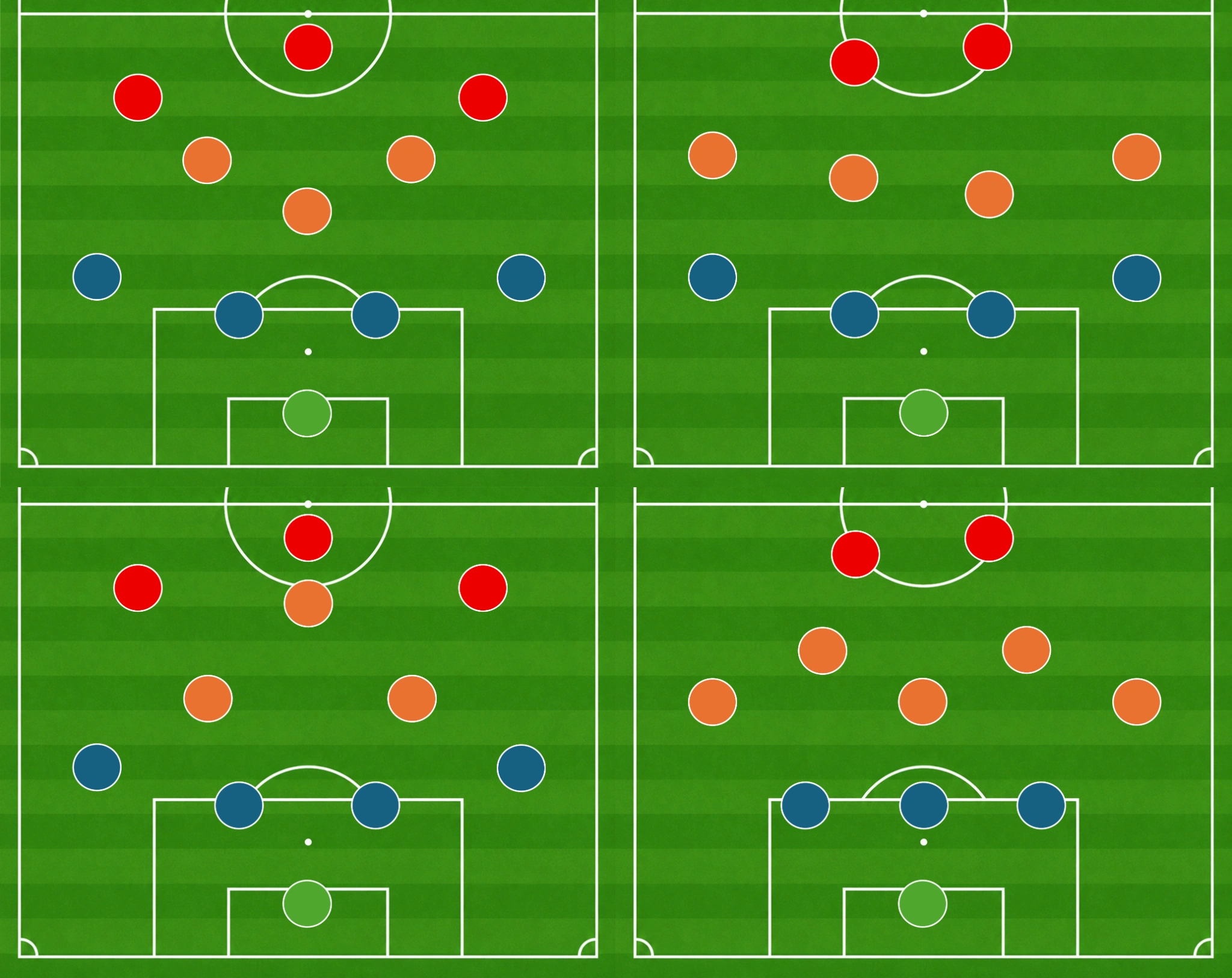
How formations are written
Reading the numbers is straightforward once you know the convention.
Three-number formations
Used when the midfield can be read as a single line. Examples include 4-3-3, 4-4-2, 4-5-1 and 3-5-2.
Four-number formations
Used when the midfield clearly splits into two lines. Examples include 4-2-3-1, 4-3-1-2, 4-3-2-1 and 3-4-2-1.
From back to front
Always read in order — defence first, then midfield, then attack. The numbers add up to ten outfield players.
The goalkeeper
Always included in the team but never in the formation number. A 4-3-3 has eleven players in total — four defenders, three midfielders, three attackers and a goalkeeper behind them.
The most common modern formations
Most professional teams use one of a small number of formations as their base shape.
4-3-3
Four defenders, a midfield three and a front three. Common in possession-based teams. The midfield three usually has one defensive midfielder and two more attacking ones; the front three has a centre forward and two wide forwards.
Read about 4-3-34-4-2
Four defenders, two central midfielders, two wingers and two strikers. The classic English formation. Less common at the very top of the modern game but still widely used at every level below it.
Read about 4-4-24-2-3-1
Four defenders, two holding midfielders, three attacking midfielders and a single striker. The two holding midfielders are often called a double pivot. A flexible formation that can shift between defensive and attacking shapes easily.
Read about 4-2-3-13-5-2
Three centre backs, two wing backs, three central midfielders and two strikers. The wing backs cover the wide areas alone. Common in counter-attacking teams and in teams with two strong central forwards.
Read about 3-5-23-4-3
Three centre backs, two wing backs, a midfield two and a front three. Aggressive in attack, demanding for the wing backs. Often used by possession teams who also want a clear front line.
Read about 3-4-3Other formations
Several other formations are used regularly. Most are variations of the common formations above, adapted to be more defensive or to use a different attacking shape.
4-5-1
A defensive variation of 4-3-3 — the wide forwards drop into the midfield line, leaving five players across the middle and a single striker. Used by teams defending deep and looking to counter-attack.
4-1-4-1
Another defensive variation of 4-3-3, with one defensive midfielder behind a midfield four. Flexible — it can push forward into a 4-3-3 in attack, or drop back into a 4-5-1 when defending deep.
3-4-2-1
A variation of 3-4-3 with two attacking midfielders behind a lone striker instead of wide forwards. Common in possession-based teams using a back three.
5-3-2
A defensive variation of 3-5-2, with the wing backs sitting deep alongside the three centre backs. Used by teams absorbing pressure and looking to counter-attack.
Older formations
A few formations from football's history are no longer used in the modern game, but they appear often in writing about how the sport developed.
The 2-3-5, known as the pyramid, was the dominant shape in early football. Five forwards stretched across the front, three half-backs behind them, and only two defenders. It reflected a game far more focused on attack than the modern one.
The WM (3-2-2-3) replaced the pyramid in the 1920s and 1930s. It pulled players back from the front line to create more balance between attack and defence. Variations of the WM shaped tactical thinking for decades before back-four formations took over.
Base shape, attacking shape and defensive shape
A team's listed formation is usually its base shape, not the exact shape it holds for the whole match.
In possession, the same team may push full backs high, move a midfielder into the back line or create a front five. Out of possession, the same players may drop into a compact block. This is why a team described as 4-3-3 may attack as a 3-2-5 and defend as a 4-5-1.
This shape-shifting is one reason formation alone never tells the whole story. The base shape tells you how the team is organised, but the attacking and defensive shapes show how the team actually behaves in different phases of play.
How a manager picks a formation
A formation is chosen to suit the players available, the opposition, and the manager's preferred playing style.
Some managers stick to one formation that suits their players or playing style. Others choose a different formation each match, based on the opposition. Most sit somewhere in between — a preferred shape with a few alternatives ready when needed.
The most important factor is usually the players. A team with two excellent strikers will often play 4-4-2 or 3-5-2 to use them both. A team with one outstanding striker and several creative midfielders often plays 4-2-3-1. A team built for pressing will usually use a shape that can push several players forward, such as 4-3-3, 4-2-3-1 or 3-4-3.
The choice of formation and the choice of playing style usually go together. Both are shaped by the players available, and some formations naturally suit certain styles. A possession team is more likely to use 4-3-3, 4-2-3-1 or a back-three shape than a flat 4-4-2. A counter-attacking team may prefer 4-4-2, 4-5-1 or 3-5-2, but the same formation can be adapted in different ways.
Formations across the match
A team often shifts between formations during a single game.
A team chasing a goal late in the match might switch from 4-3-3 to 4-4-2, bringing on an extra striker. A team holding a lead might switch from 4-3-3 to 4-5-1, dropping a winger deeper to defend. These changes are usually made through substitutions but can also happen through positional changes alone.
This kind of in-game adjustment is part of match strategy. Knowing which formation suits which situation is one of the things that separates an experienced manager from a less experienced one.
What to read next
Once formations make sense, the natural next step is to look at the styles teams play within them.