
Domestic football
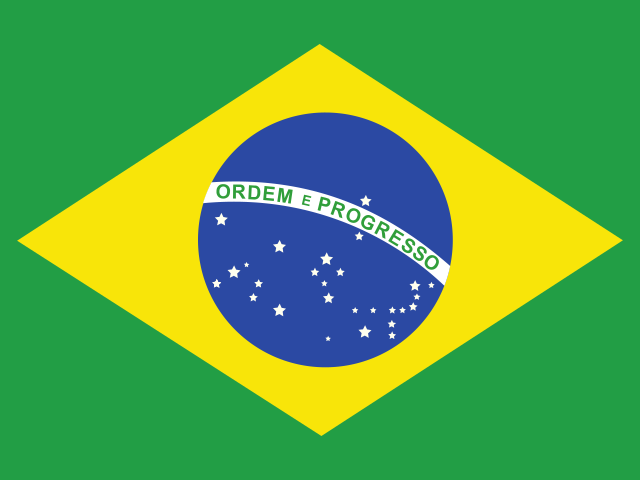
The Copa do Brasil
The Copa do Brasil is Brazil's main domestic cup competition. Founded in 1989, it brings together clubs from all 26 Brazilian states and the Federal District in a national knockout tournament. From 2026, the competition has 126 clubs and a single-match final in December. It is one of Brazil's major domestic trophies, alongside the Brasileirão, and offers a direct route into the Copa Libertadores.
What the Copa do Brasil is
The Copa do Brasil is Brazil's main national cup competition.
The Copa do Brasil is a nationwide knockout competition run by the Brazilian Football Confederation, known as the CBF. Its field has changed over time, but the 2026 edition expanded to 126 clubs, including teams from Série A, clubs qualifying through state competitions, and selected regional and lower-division champions.
The competition was launched in 1989 to give clubs from smaller Brazilian states a route into national football. Before then, Brazil's national calendar was centred heavily on the Brasileirão and the country's powerful state championships. The Copa do Brasil opened the door to clubs from regions less well-represented in the top flight and has produced regular giant-killing moments alongside big-club runs to the final.
How the tournament is organised
The Copa do Brasil is a knockout competition, but its exact format has changed over time.
The current format uses nine phases. The first four phases are single-match knockout ties, followed by two-legged ties from the fifth phase through to the semi-finals. The final is a single match, with the CBF responsible for confirming the host stadium and match arrangements.
In the single-match phases, a level score is settled by penalties. In the two-legged phases, the tie is decided first by results over the two matches, then by goal difference and penalties if needed. The Copa do Brasil previously used an away-goals rule, but the CBF removed it from the 2018 edition.
From 2026, the 20 Série A clubs enter in the fifth phase. A smaller group of regional and lower-division champions enter in the third phase, while the other entrants begin earlier according to the competition regulations and the CBF club ranking. This replaced the older structure in which clubs involved in the Copa Libertadores entered later in the tournament.
When the competition takes place
The Copa do Brasil runs across much of the Brazilian football season.
The competition usually begins early in the year and runs alongside the Brasileirão, state competitions and continental tournaments. In the 2026 calendar, the opening phase began in February and the final is scheduled as a single match in December.
The calendar has changed several times as the CBF has tried to balance national competitions, state championships and continental football. Older editions ended with a two-legged final, but the 2026 reform moved the final to a single match. The competition's prize money also makes it especially important for smaller clubs, because each round can bring useful income as well as national exposure.
Who can enter
The Copa do Brasil is open to clubs from across Brazil's football pyramid.
For the 2026 edition, the 126 places are divided into three main routes. The 20 Série A clubs qualify, four places go to the champions of the Copa do Nordeste, Copa Verde, Série C and Série D from the previous season, and 102 places are allocated through state competitions. Those state places are distributed across Brazil's 26 states and the Federal District according to CBF criteria.
The structure deliberately spreads the competition beyond Brazil's richest and most visible clubs. The CBF regulation also states that the field is due to expand to 128 clubs from 2027, with additional regional competition places added.
Two clubs from outside Série A have won the Copa do Brasil: Santo André in 2004 and Paulista in 2005, both from Série B. In 2008, Sport Recife became the first winners from outside Brazil's Southeast and South regions, a significant moment in the competition's geographic spread.
What clubs qualify for
The Copa do Brasil provides a route into the Copa Libertadores.
The Copa do Brasil champions qualify for the next Copa Libertadores group stage. Under the 2026 regulations, the runners-up also receive a place in the preliminary phase, subject to redistribution rules if either finalist has already qualified through another route.
The exact allocation can depend on the Brasileirão table, other continental qualification routes and CONMEBOL eligibility rules. In practice, this makes the Copa do Brasil one of the most valuable domestic competitions in Brazil, because it can offer both a major trophy and a route into South America's top club competition.
The competition's prize money makes it commercially significant for smaller clubs as well as the bigger ones. Even early-round wins can generate meaningful revenue, which is one reason the Copa do Brasil matters so much to clubs outside Série A.
The most successful clubs
A small group of clubs has dominated the Copa do Brasil since it began in 1989.
Cruzeiro
Six titles, the most of any club. Cruzeiro's record includes back-to-back Copa do Brasil wins in 2017 and 2018. The club also won the Brasileirão and Copa do Brasil in the same year in 2003, a domestic double later matched by Atlético Mineiro in 2021.
Grêmio and Flamengo
Five titles each. Grêmio won the inaugural 1989 Copa do Brasil, beating Sport Recife in the final, and have remained one of the competition's most successful clubs. Flamengo's five titles span from 1990 to the modern era, including wins in 2022 and 2024.
Palmeiras and Corinthians
Four titles each. Palmeiras lifted the cup in 1998, 2012, 2015 and 2020. Corinthians won in 1995, 2002, 2009 and 2025, with the 2025 title moving them level with Palmeiras on four Copa do Brasil wins.
Atlético Mineiro
Two titles, in 2014 and 2021. Atlético Mineiro's 2021 cup win came alongside their Brasileirão title that year, making them the second Brazilian club after Cruzeiro to win those two national trophies in the same season.
Outside the major regions
Sport Recife's 2008 win was the first Copa do Brasil title for a club from outside the Southeast or South regions of Brazil. Vitória and Ceará have reached finals without winning the cup, while clubs from the North and Centre-West regions have not yet won the competition.
Surprise winners
Santo André's 2004 Copa do Brasil win is widely regarded as one of the competition's biggest shocks, with the small São Paulo state club beating Flamengo in the final. Paulista's 2005 win, also by a smaller São Paulo club, came a year later. Both clubs were playing in Série B at the time, making them the only second-tier clubs to have won the cup.
A short history
The Copa do Brasil was launched in 1989 and has been held every year since.
The competition was created in 1989 to expand Brazilian football's national reach. State football federations representing smaller regions had argued that their clubs needed a national competition that would give them a chance against the big-city clubs, particularly after the 1987 Copa União split that reduced their representation in the top division. The CBF launched the Copa do Brasil with 32 clubs, and Grêmio won the first edition by beating Sport Recife over a two-legged final.
The field has grown significantly across the modern era. It expanded from 32 clubs in 1989 to 92 clubs in the early 2020s, then to 126 clubs in 2026, with a further expansion to 128 clubs planned from 2027. These changes reflect the CBF's attempts to balance calendar pressure, national representation, state competitions and the demands on clubs also playing in continental tournaments.
The move to a single-match final from 2026 is one of the most significant format changes in the competition's modern history. It marks a clear break from the traditional two-legged final and brings the Copa do Brasil closer to the recent model used in South America's major continental finals.
What to read next
The natural next steps are the Brasileirão or the Copa Libertadores.