
Attack
Attackers and forwards
Attackers, also called forwards, are the players furthest up the pitch. Their main job is to score and create goals. This guide explains the main forward positions and how front lines are arranged in modern football.
What attackers do
Attackers are the players closest to the opposition goal. Most teams set up with one, two or three of them.
An attacker's main job is to score or create goals. Strikers usually carry the greatest scoring responsibility, while wide forwards and wingers may be just as important for chance creation, movement and pressing.
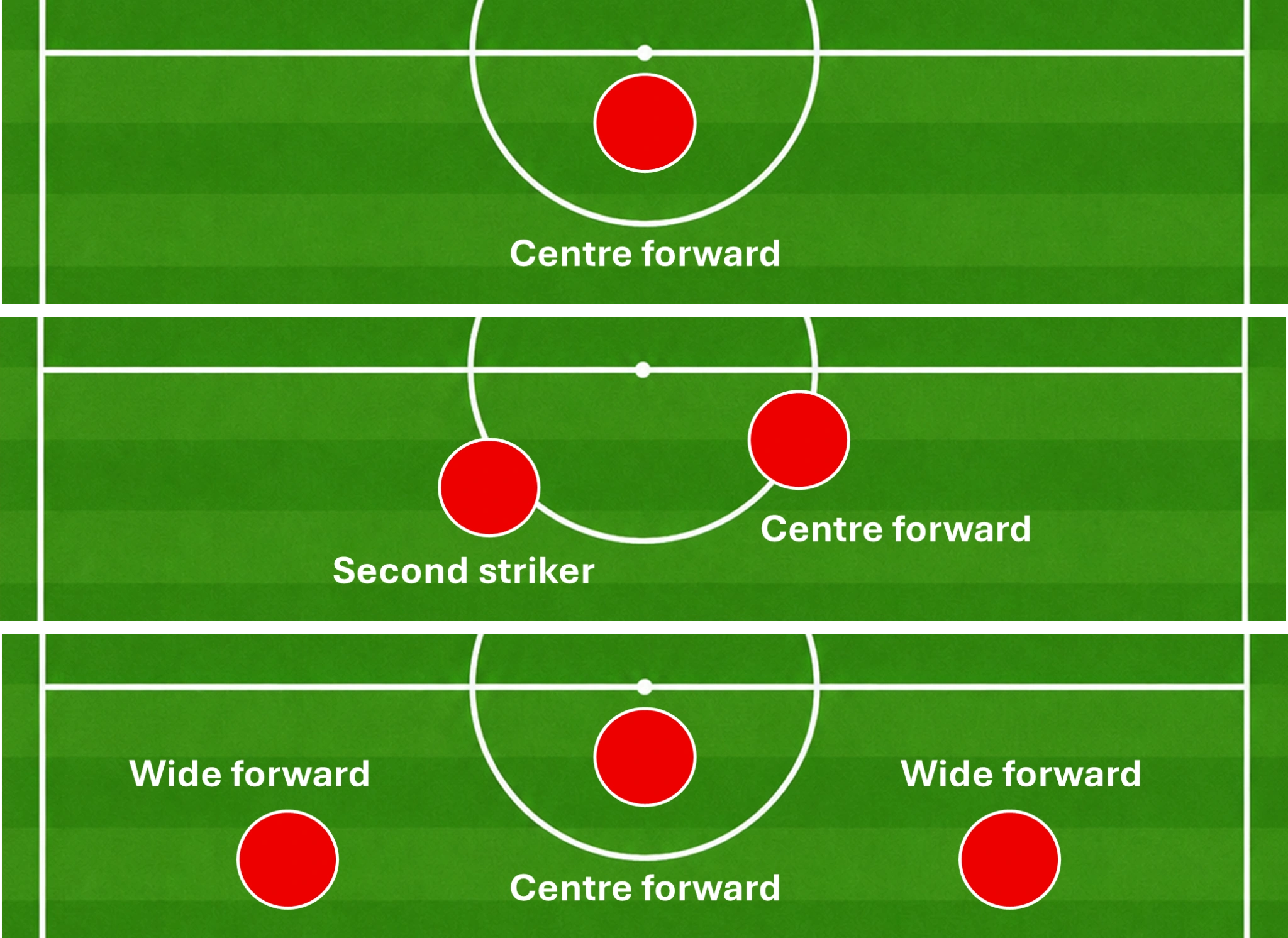
The shape of the front line depends on the formation. A 4-4-2 has two strikers playing together. A 4-3-3 has a centre forward with a wide forward on each side. A 4-2-3-1 has a single striker supported by an attacking midfielder and two wingers behind them.
Forward is a broad word for attacking players. A striker is a more specific kind of forward who normally plays through the middle and leads the line.
The main attacking positions
Most attackers fit into one of a small number of recognisable positions.
Strikers
The forwards at the top of the team. The centre forward leads the line and scores most of the team's goals. The second striker plays just behind in two-striker formations, linking midfield to attack.
Read about strikersWingers and wide forwards
An attacker who plays from a wide area. Traditional wingers stay near the touchline to dribble and cross, while inverted wingers and wide forwards move inside to shoot or combine with strikers.
Read about wingers and wide forwardsStrikers
The strikers are the players at the top of the team, with the centre forward leading the line and the second striker playing just behind in two-striker formations.
A centre forward plays in the middle of the front line. They occupy the centre backs, get on the end of crosses, and finish chances inside the penalty area. Many centre forwards are strong in the air and have a good first touch, but modern centre forwards can also be smaller, mobile link players who create space through movement.
A second striker plays just behind the centre forward in two-striker formations. They drop a few yards deeper to receive passes between the opposition's defence and midfield, then turn and play forward. The two-striker partnership is the team's main attacking idea in formations like 4-4-2 and 3-5-2.
Wingers and wide forwards
A front three usually has wide forwards on each side of a centre forward.
Wide forwards in a 4-3-3 start near the touchlines and cut inside to shoot or combine with the central striker. Many of them are "inverted" — left-footed on the right wing, right-footed on the left — so they can move onto their stronger foot when they cut inside.
This is different from a traditional winger in a 4-4-2, who stays wider, beats the full back on the outside and crosses for the strikers in the middle. Both still exist in modern football, but inverted wide forwards are more common at the top of the game.
The link with attacking midfielders
Attackers depend on the players behind them for service and combinations.
A centre forward needs passes into feet, crosses into the box or balls into space behind the defence. Wide forwards often need an attacking midfielder to combine with them in the half-spaces. The front line and the attacking midfield line therefore work as one unit.
This is especially clear in 4-2-3-1 systems, where the striker, number 10 and two wingers form a connected attacking band.
Where this fits in tactics
How a front line is set up depends on the team's overall style of play.
A counter-attacking team often uses a fast lone striker who can run in behind, with quick wingers breaking forward on either side. A possession team often uses a centre forward who can hold the ball up, with wide forwards who drift inside to combine with the midfield. A high-pressing team needs forwards across the whole front line who are willing to chase the ball, block passing lanes and become the first line of pressure.
Specific tactical roles for the front line — target man, poacher, false nine, complete forward, pressing forward, traditional winger, inverted winger, inside forward — are explained in detail in the tactics section. The full guide to attacking roles, and which ones fit which system, is the natural next step.
What to read next
Attackers connect to the midfield behind them and to the wide players on either side.