Position guide
Football positions explained
A football team is made up of eleven players in four broad areas — goalkeeper, defence, midfield and attack. This guide walks through each area and the positions within it, in plain English.
How a team is set up
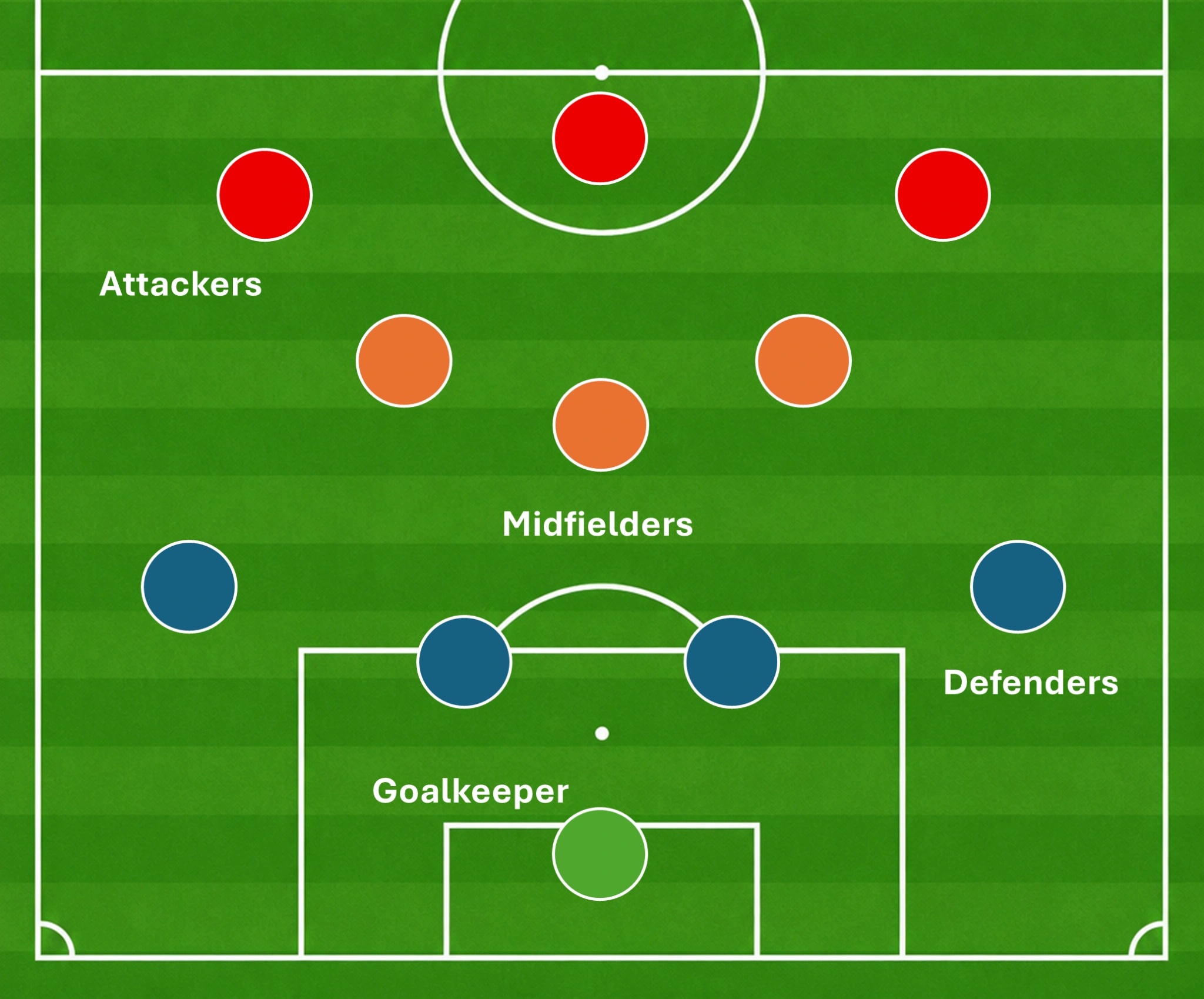
A football team has eleven players, with one player as goalkeeper and ten outfield players split between defence, midfield and attack.
The goalkeeper is the only player allowed to use their hands inside their own penalty area. The ten outfield players are arranged in front of the goalkeeper according to the team's chosen formation, with the balance between defenders, midfielders and attackers depending on how the manager wants the team to play.
The traditional starting point is to think of the team as a back line, a midfield and a front line. Inside each of those, there are more specific positions — centre backs and full backs in defence, defensive, central and attacking midfielders in midfield, and centre forwards and wingers in attack.
Positions and roles are not the same thing
A position describes a player’s basic place within the team’s formation — the general area of the pitch they are responsible for. A role explains what the player is expected to do from that position.
Centre back, full back, defensive midfielder and striker are positions. Ball-playing centre back, inverted full back, deep-lying playmaker and false nine are tactical roles built on top of those positions.
This section explains where players sit and what the basic positions mean. The tactics section then explains the more specific roles managers use within those positions.
The goalkeeper
The goalkeeper is the only specialist position in football, with rules and equipment of their own.
The goalkeeper stays close to their own goal and is the last line of defence. They can use their hands and arms inside their own penalty area, but not outside it. Goalkeepers wear a different colour shirt from their teammates so the referee and other players can identify them quickly.
Beyond shot-stopping, modern goalkeepers are expected to come off their line to claim crosses, organise the defenders in front of them, and start attacks with passes from the back.
The defenders
Defenders form the back line of the team and are the outfield players closest to their own goal.
Centre backs
Two or three players who occupy the middle of the back line. Their main job is to stop attackers from getting clear chances on goal — by intercepting passes, winning headers, and tackling cleanly.
Read about centre backsFull backs and wing backs
Full backs play on the left and right of the back line. They defend wide areas and join in with attacks down the touchline. In a back-three system they are replaced by wing backs pushed further forward.
Read about full backs and wing backsThe midfielders
Midfielders link the defence to the attack and are usually among the players who cover the most ground in a match.
Defensive midfielders
Players who sit just in front of the defence, breaking up opposition attacks and starting moves with passes. Often called the holding midfielder, the anchor or the number 6.
Read about defensive midfieldersCentral midfielders
Runners, often called the number 8, who help in defence and attack. They cover the middle of the pitch, support the defenders behind them and the attackers in front.
Read about central midfieldersAttacking midfielders
Players who operate between midfield and attack, creating chances for the forwards. The classic number 10 is an attacking midfielder.
Read about attacking midfieldersWingers and wide midfielders
Wide players who attack down the touchlines, deliver crosses or cut inside towards goal. They are midfielders in deeper systems and forwards in higher front-three systems.
Read about wingers and wide midfieldersThe attackers
Attackers, also called forwards, are the players furthest up the pitch and are responsible for scoring and creating goals.
Strikers
The forwards at the top of the team. The centre forward leads the line and scores most of the team's goals. The second striker plays just behind in two-striker formations, linking midfield to attack.
Read about strikersWingers and wide forwards
An attacker who plays from a wide area. Traditional wingers stay near the touchline to dribble and cross, while inverted wingers and wide forwards move inside to shoot or combine with strikers.
Read about wingers and wide forwardsModern hybrid roles
A handful of modern roles do not fit neatly into one area of the pitch.
Some positions exist only in certain systems. Wing backs combine full-back defending with winger-style attacking. Inverted full backs move into midfield when their team has the ball. Inverted wingers play on the opposite side from their stronger foot so they can cut inside to shoot. False nines drop into midfield as a fake centre forward.
These hybrid roles are increasingly common at the top of the game. They are best understood once the traditional positions are clear.
What to read next
Once the positions make sense, the next step is to see them in numbers and shapes.