Goalkeeper
The goalkeeper
The goalkeeper is the only specialist position on the pitch — and the only player allowed to use their hands inside their own penalty area. This guide explains the responsibilities of the position, how they have changed and how a modern goalkeeper helps build attacks as well as stop shots.
What the goalkeeper does
The goalkeeper is the last line of defence and the player closest to their own goal.
The goalkeeper's first job is to stop the opposition from scoring. They make saves from shots, claim crosses delivered into the penalty area, and step out to deal with through balls played in behind the defence. They also organise the defenders in front of them, calling for cover and warning of unmarked attackers.
Goalkeepers wear a different colour shirt to their teammates so they can be picked out quickly by the referee and other players. They are usually identified by squad number 1, although shirt numbers are not as fixed as they used to be.
When goalkeepers can use their hands
The handling rules for goalkeepers are precise and worth knowing.
A goalkeeper can use their hands inside their own penalty area. Outside it, they are treated like any other player. Inside the area, they cannot pick up a deliberate kicked back-pass from a teammate or handle the ball directly from a teammate's throw-in.
They also cannot control the ball with their hands or arms for more than eight seconds. The referee decides when control begins and visually counts down the final five seconds with a raised hand. If the goalkeeper still does not release it, the opposition are awarded a corner kick.
Shot-stopping
The most visible part of goalkeeping is the save.
Reflex saves
Quick reactions to close-range shots and deflections. Reflex saves rely on positioning more than speed — a goalkeeper in the right place barely has to move.
Diving saves
Full-stretch saves to corners of the goal. The goalkeeper pushes off with the leg nearest the ball and uses the strong hand to keep the shot out or palm it wide.
Smothering
Coming out quickly to a one-on-one and making the body big to block the shot, often falling at the attacker's feet to take the ball cleanly.
Tipping over
Dealing with high or curling shots by deflecting the ball over the bar with the fingertips rather than trying to hold it.
Claiming crosses
A goalkeeper who controls their penalty area is one of the most valuable defenders a team has.
When the ball is crossed into the penalty area, the goalkeeper has to decide quickly whether to come off their line to claim it or stay on the line and trust the defenders. A clean catch ends the danger and starts a quick counter-attack. A punch clears the ball under pressure when a catch is not possible.
Coming for a cross is risky. If the goalkeeper misses it, the ball usually drops to an attacker in front of an open goal. Goalkeepers learn to judge crosses by reading the trajectory and the body shape of the player crossing the ball.
Distribution
How the goalkeeper restarts play has become a major part of how teams build attacks.
Short passes
Used to start moves from the back. The goalkeeper rolls or passes the ball to a defender stepping into space, with the team trying to draw the opposition forward and play through them.
Read more in the tactics section: playing out from the backLong kicks
Used to skip the midfield and find a forward player. Long kicks are most common when a team wants to attack quickly or when the opposition is pressing aggressively.
Goal kicks
Restarts after the ball goes out behind the goal line. The rules now allow defenders to receive a goal kick inside the penalty area, which has made playing out from the back much easier.
Read about goal kicksFree kicks at the back
Defensive free kicks taken by the goalkeeper, usually played short to a defender to start a controlled attack.
Read about free kicksWorking with the defence
A goalkeeper is part of the defensive unit, not separate from it.
The goalkeeper constantly talks to the defenders in front of them. They call when to leave a ball, when to clear it, when to step up and when to mark a runner. Good communication prevents simple mistakes around crosses, through balls and set pieces.
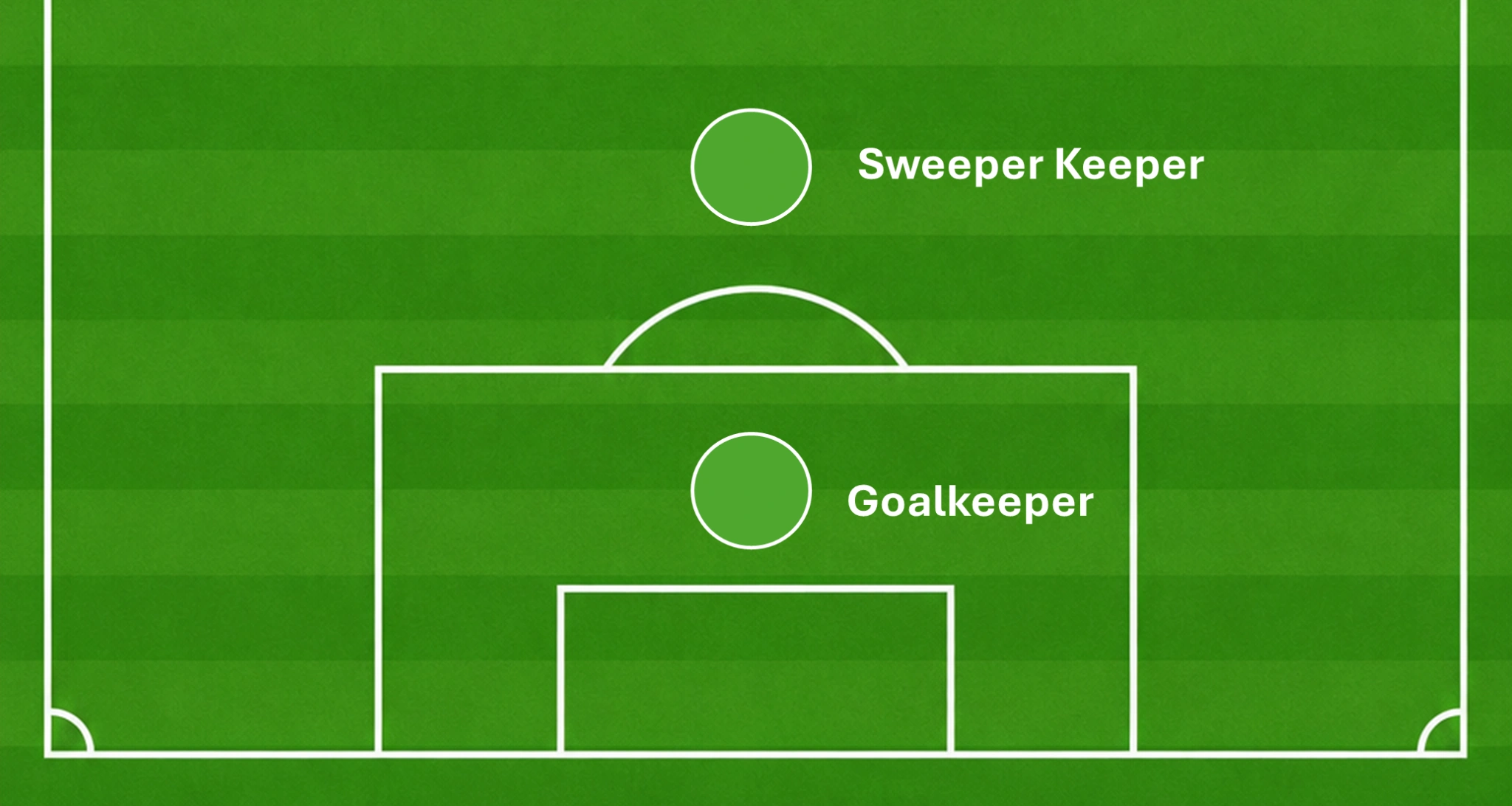
The goalkeeper's starting position also depends on the back line. A team defending deep usually keeps the goalkeeper closer to goal. A team using a high defensive line needs the goalkeeper ready to sweep up passes played into the space behind.
How the position has changed
The goalkeeper of today does very different things to the goalkeeper of thirty years ago.
Two changes shaped the modern goalkeeper. The first was the back-pass rule, which stopped goalkeepers from picking up a deliberate kicked pass from a teammate. The second was the goal-kick rule change in 2019, which lets defenders collect the ball inside the penalty area.
Both changes pushed goalkeepers away from being shot-stoppers alone and towards being players involved in build-up. A modern top-level goalkeeper is judged on passing as much as on saves. The biggest split has been between sweeper-keepers, who play well off their line and join the build-up, and traditional shot-stoppers, who stay closer to goal — different roles built on the same position.
Where this fits in tactics
The kind of goalkeeper a team uses depends on its wider system.
A possession team usually wants a goalkeeper comfortable on the ball under pressure, capable of passing through a press and starting attacks with their feet. A high-pressing team needs a sweeper-keeper who can cover the space behind a high defensive line. A team that defends deep can rely more on a traditional shot-stopper, since there is less space behind the back line to defend.
The choice of goalkeeper shapes the rest of the team's setup, especially how high the defensive line plays and how the team builds up from the back. The full guide to the different goalkeeper roles, and which one fits which system, sits in the tactics section.
What to read next
The goalkeeper plays just behind the back line, so the natural next step is the defenders themselves.