Shirt numbers
Football shirt numbers explained
Football shirt numbers used to map directly onto positions, with each number worn by the player in a specific role. Squad numbers have changed that — but the traditional link is still part of the language of the game.
Where shirt numbers come from
Shirt numbers were originally a direct link to a player's position on the pitch.
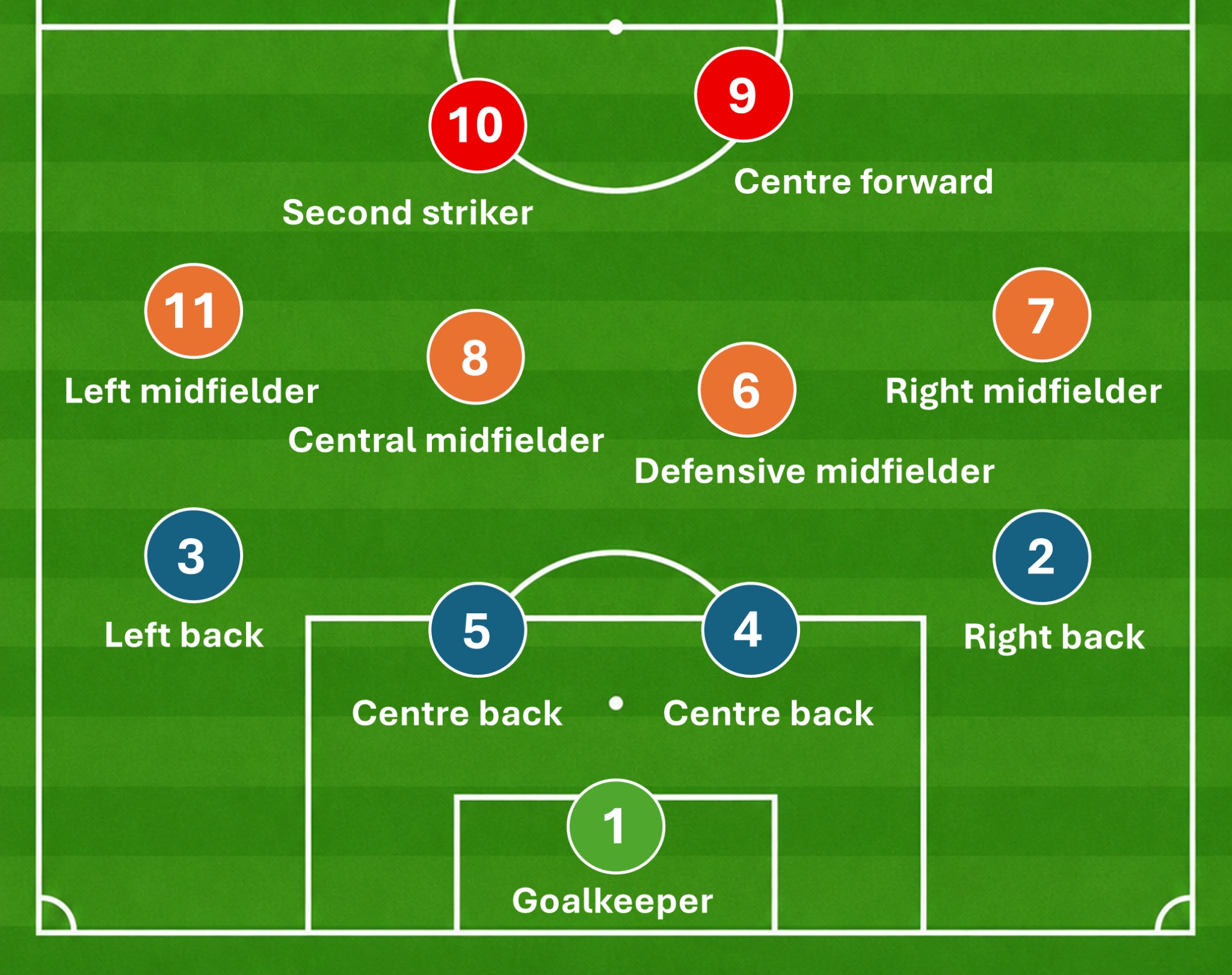
In the traditional 1 to 11 numbering system, each shirt number was linked to a position on the pitch. The numbers started with the goalkeeper and moved out through the team; within each line, they ran from right to left. Number 1 was the goalkeeper, 2 was the right back, 3 was the left back, and the sequence continued up to 11 on the left wing.
This worked because teams often used similar formations. In the old 2-3-5 shape, the centre forward wore number 9, with the inside forwards either side wearing 8 and 10, and the wingers wearing 7 on the right and 11 on the left. Later formations such as 4-4-2 changed how the numbers fitted on the pitch, but the basic idea remained: for example, the number 9 was still understood as the main centre forward.
The traditional numbers and positions
The classic shirt numbers map onto a 4-4-2 starting eleven.
| Number | Position | Notes |
|---|---|---|
| 1 | Goalkeeper | The only number that has stayed firmly attached to a single position. |
| 2 | Right back | Originally the right of the back two, now the right of the back four. |
| 3 | Left back | Originally the left of the back two, now the left of the back four. |
| 4 | Centre back | Used by the deeper centre back, sometimes also given to a defensive midfielder. |
| 5 | Centre back | Used by the other centre back. Sometimes worn by the senior or more attacking of the pair. |
| 6 | Defensive midfielder | The classic holding midfielder. In some countries, used for a centre back. |
| 7 | Right midfielder or right winger | A famous attacking number, often given to the team's main wide attacker. |
| 8 | Central midfielder | The box-to-box midfielder, working between defence and attack. |
| 9 | Centre forward | The number associated with the main striker. |
| 10 | Attacking midfielder or second striker | The classic creative number, worn by the team's main playmaker. |
| 11 | Left midfielder or left winger | The wide attacker on the left side of the pitch. |
Numbers in different formations
The traditional numbering fits a 4-4-2 most directly, but the same numbers carry over into modern shapes.
In a 4-3-3, the wingers (7 and 11) play higher up the pitch and the central midfielder (8) is one of three midfielders rather than two. In a 4-2-3-1, the 10 sits alone behind a single 9, with two holding midfielders behind them.
How squad numbers changed things
Modern football uses squad numbers, which weakened the link between numbers and positions.
Squad numbers were introduced widely in the 1990s. Each player in the squad picks a number for the season and keeps it whether they are starting or on the bench. That ended the system where the eleven starters wore 1 to 11.
In practice, players still try to take the number their position has traditionally worn — strikers want 9, attacking midfielders want 10, goalkeepers want 1. But high squad numbers have become normal, and a player in the number 27 shirt could be playing anywhere on the pitch.
Numbers describe roles as well as shirts
Traditional numbers are still used as shorthand even when players no longer wear the literal shirt number.
A team can talk about needing a number 6, number 8, number 9 or number 10 even if the player wearing that shirt is someone else. In that context, the number describes a role or position type rather than the printed number on the back of the shirt.
This is why shirt numbers still matter in football language. They help explain the difference between a holding midfielder, a box-to-box midfielder, a centre forward and a creative attacking midfielder.
Iconic numbers
A few numbers have become so closely tied to a role that the number itself is shorthand for it.
Number 9
The classic centre forward. Saying a team "needs a number 9" almost always means they need a main striker.
Read about centre forwardsNumber 10
The creative playmaker. The number 10 is associated with skilful attacking players who create chances between the lines.
Read about attacking midfieldersNumber 6
The defensive midfielder. In English football, the number 6 sometimes refers to a centre back instead — both meanings are still in use.
Read about defensive midfieldersNumber 7
The main wide forward. The number is associated with skill and goals from wide positions.
Read about wide forwardsNumber 1
The goalkeeper. This is the one number that has kept its meaning intact in the squad-number era.
Read about goalkeepersNumber 8
The box-to-box midfielder. The number 8 links defence to attack and often covers large distances across midfield.
Read about central midfieldersNumbers in different countries
The traditional numbering is mostly British and Western European. Other countries do things differently.
In some South American countries, the number 5 is given to the defensive midfielder rather than a centre back. In some systems, the number 6 is used for a defender rather than a midfielder. These differences come from different historical formations and have stuck around even as the modern game has converged on similar shapes.
This is part of why some players keep an unusual squad number throughout their career — the number reflects how they were brought up in the game, not necessarily where they play in their current team.
What to read next
Shirt numbers are tied to positions, so the natural next step is to look at the positions in more detail.