Defence
Defenders and the back line
The back line is the foundation of any football team. This guide explains how defenders are organised, what each one does, and the difference between a back four and a back three.
What defenders do
Defenders are the players closest to their own goal and are responsible for stopping the opposition from scoring.
Defending is more than tackling. The best defenders read the game, anticipate passes, position themselves to make attacks predictable, and only commit to a tackle when they are confident of winning the ball. They also keep the back line organised — staying compact, holding a flat shape, and stepping up together to play attackers offside.
In the modern game, defenders are also expected to start attacks. Centre backs play forward passes through the lines, full backs join attacks down the touchlines, and the back line as a whole helps the team keep the ball under pressure.
The back four
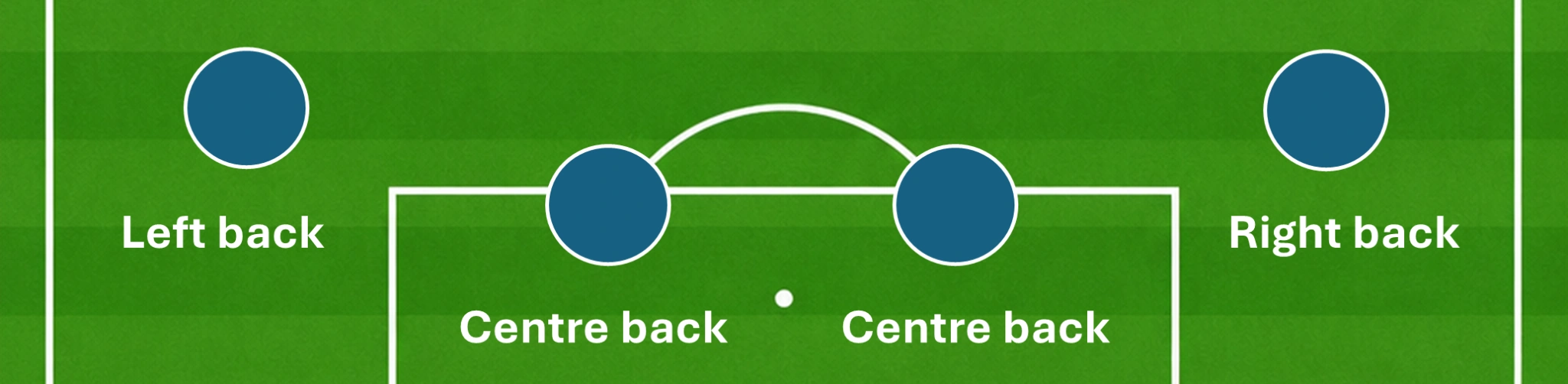
A back four is the most common defensive shape in football, with two centre backs and two full backs.
Two centre backs
The centre backs sit in the middle of the back line, defending the central area in front of the goal. They mark the main strikers, win headers from crosses, and clear long balls played into the box.
Read about centre backsTwo full backs
A left back and a right back play on the outside of the centre backs. They defend the wide areas, support the midfield in possession, and often join attacks by overlapping the wingers in front of them.
Read about full backsHolding a line
The back four moves up and down the pitch as a single unit. Holding a flat line lets the team play attackers offside and keeps the defence compact.
Switching sides
A back four works in pairs. On the side the ball is on, the full back presses while the centre back covers behind. On the far side, the opposite full back tucks in closer to the centre backs, narrowing the back line and protecting the middle of the pitch.
The back three
A back three uses three centre backs across the defence, supported by wing backs in front of them.
A back three is the main alternative to a back four. Three centre backs cover the width of the pitch, with two wing backs further forward providing the width that full backs would in a back four. This system is common in 3-5-2 and 3-4-3 formations.
Three at the back gives a team an extra defender in central areas, which makes it harder to break down through the middle. The trade-off is that the wing backs cover more ground than a full back, and the wide defenders need to be comfortable defending one-on-one when the wing back is out of position.
Defending in pairs
In a back four centre backs most commonly play in a pair, and the partnership matters.
The two centre backs in a back four share the central defensive duties. They mark the strikers between them, decide who steps out to challenge and who stays back to cover, and communicate constantly about the offside line.
Many partnerships work because the two players bring different qualities. A common pairing has one defender who is strong in the air and likes to mark tightly, with a second who is quicker, reads the game and plays the ball out from the back. The contrast between the two makes the partnership flexible.
Defenders and the offside trap
The offside trap is one way the back line turns good positioning into an active defensive weapon.
The offside trap only works if the defenders move together. Centre backs usually organise the line, while full backs or wing backs must stay level with them so they do not accidentally play an attacker onside.
This is why defending is not just about individual duels. A good back line communicates, holds its shape and steps forward at the right moment. When the timing is right, a forward run that looks dangerous becomes an offside offence instead.
Defensive line height
The back line can defend high, deep or somewhere in between, and that choice changes what defenders need to do.
A high defensive line keeps the team compact and helps a pressing side squeeze the pitch, but it leaves space behind for fast attackers to run into. Centre backs need pace and good timing, while the goalkeeper may need to act as a sweeper behind them.
A deeper defensive line protects the space behind the defence and suits teams that want to absorb pressure, but it can leave more room in midfield. The best defensive shape depends on the team's pressing, midfield cover and overall playing style.
Wide defenders in attack
Modern full backs and wing backs are as much attacking players as defensive ones.
Overlapping
A full back runs past the winger on the outside to deliver a cross or stretch the defence. This was the classic full back attacking move and is still common in possession-based football.
Underlapping
A full back runs inside the winger rather than outside. This usually happens when the winger stays wide with the ball, leaving the inside channel or half-space open for the full back to attack.
Inverted full backs
Full backs who move into central midfield when their team has the ball, helping to control possession and add an extra body to the midfield.
Wing backs
Used in a back three. They play almost as wingers in attack and full backs in defence, covering the entire wide area on their side of the pitch.
Where this fits in tactics
How a back line is set up depends on the team's overall style of play.
A counter-attacking team often plays with a deeper back line and full backs who can break forward quickly when possession is won. A possession team usually wants ball-playing centre backs who can pass through the lines, with inverted full backs stepping into midfield to help control the game. A high-pressing team needs a high back line and defenders who are quick across the ground and comfortable defending the space behind them when the press is broken.
Specific tactical roles for defenders — ball-playing centre back, stopper, libero, traditional full back, attacking full back, inverted full back, wing back — are explained in detail in the tactics section.
What to read next
The defenders connect directly to the goalkeeper behind them and the midfielders in front of them.