
Midfield
Midfielders and the engine room
Midfielders are the players who link defence to attack. They are usually among the players who cover the most ground and help decide how a team controls the ball. This guide explains the main midfield positions and how they fit together.
What midfielders do
Midfielders are the connection between defence and attack and are involved in almost every passage of play.
When the team has the ball, midfielders move it from defence to attack, control the tempo, and create chances for the forwards. When the team does not have the ball, they break up the opposition's attacks, screen the back line and start counter-attacks.
Most teams have three or four midfielders. The exact mix depends on the formation. A 4-3-3 has a midfield three. A 4-4-2 has two central midfielders and two wide midfielders. A 4-2-3-1 has two holding midfielders behind a number 10 and two wingers.
The main midfield positions
Most midfielders fit into one of a small number of recognisable positions.
Defensive midfielders
Sits just in front of the defence to break up opposition attacks and shield the back line. Often called the holding midfielder, the anchor or the number 6.
Read about defensive midfieldersCentral midfielders
A runner, commonly referred to as a number 8, who supports both defence and attack. Covers a lot of ground and is involved in most phases of play.
Read about central midfieldersAttacking midfielders
Plays between midfield and attack, creating chances for the forwards. The classic number 10 is an attacking midfielder.
Read about attacking midfieldersWingers and wide midfielders
Plays in wide areas, defends the touchline, and attacks down the wings. In some systems wingers sit further forward, almost as forwards.
Read about wingersDefensive midfielders
The player just in front of the back line is one of the most important in the team.
A defensive midfielder protects the centre backs by stepping into the gaps between defence and midfield. They intercept passes, block passing lanes, delay counter-attacks, and force the play wide where there is less immediate danger.
In possession, they often drop between the centre backs to receive the ball from the goalkeeper and start the build-up. This role is sometimes called the deep-lying playmaker when the player is more involved in passing than in tackling.
Central midfielders
The central midfielder, or number 8, sits between the defensive midfielder and the attacking midfielder and supports both ends of the pitch.
The classic central midfielder is a box-to-box player who helps in both penalty areas — defending corners and crosses at one end and arriving late in the opposition box at the other. They are usually energetic and good at both winning the ball and keeping it, and they are often among the players who cover the most ground.
Not every number 8 plays the same way. Some are more attacking and creative, drifting into the half-spaces to play forward passes and arrive on the edge of the area. Others are more disciplined, staying closer to defensive midfield to protect the back line and keep possession ticking over. The box-to-box role is most common in midfield threes, where one player can roam while the other two can divide the deeper and more attacking duties between them.
Attacking midfielders
The classic number 10 is the player who connects midfield to attack and creates chances for the forwards.
An attacking midfielder plays in the space between the opposition's midfield and defence, often called between the lines. They receive passes there, turn quickly and play forward passes to the strikers, or shoot from the edge of the area themselves. They may also drift into the half-spaces to combine with wingers, full backs and strikers.
In some modern systems the attacking midfielder is replaced by a second striker or a wide forward who drifts inside. The responsibility to create chances from between the lines still exists but is often distributed between two or three players rather than given to one specialist.
Common midfield shapes
Midfields are usually built around a small number of common shapes.
Midfield two
Two central midfielders share the work between them, as in many 4-4-2 systems. They both need to defend, pass and cover the middle of the pitch.
Midfield three
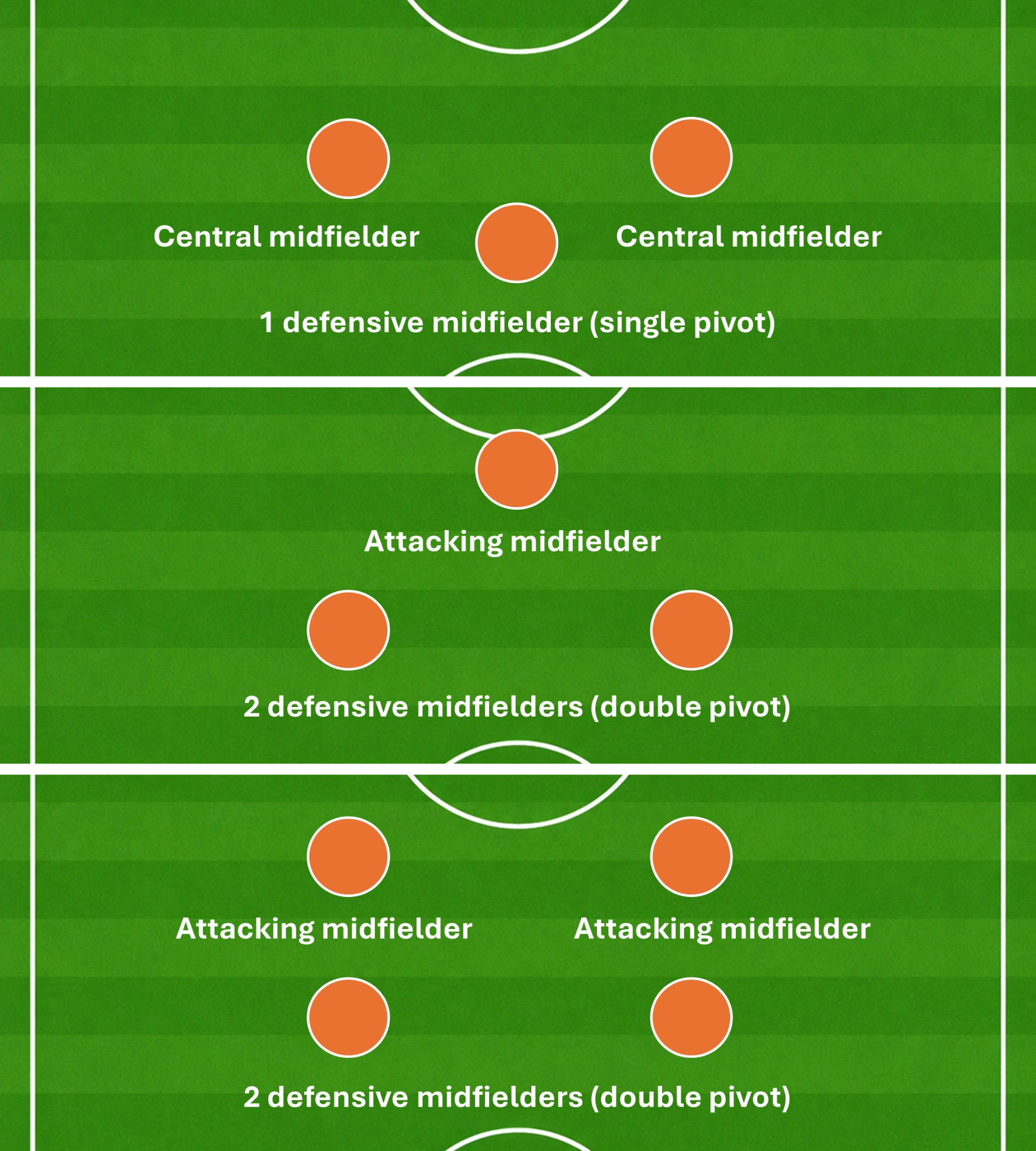
Three central players usually divide into one defensive midfielder and two number 8s, as in many 4-3-3 systems.
Single pivot
One defensive midfielder sits behind two more advanced midfielders. This gives the team extra players ahead of the ball but puts more responsibility on the pivot.
Double pivot
Two holding midfielders sit side by side, usually behind a number 10. This gives extra protection in front of the defence.
Single pivot and double pivot
A team's midfield can be built around one defensive midfielder or two.
Single pivot
One defensive midfielder behind two more attacking midfielders. Common in 4-3-3 systems. The pivot player has a lot of responsibility — they cover the whole width of the pitch in front of the back line.
Double pivot
Two holding midfielders side by side. Common in 4-2-3-1 and many 3-4-3 systems. The two players share defensive duties, with one often pushing higher than the other.
Wingers and wide midfielders
Wingers blur the line between midfield and attack, depending on the system.
In a 4-4-2, the wingers sit in the midfield line and have clear defensive duties — they help the full back behind them and track back to defend the touchline. In a 4-3-3, the wingers play higher up and are essentially forwards. In a 3-5-2, the wide players are wing backs rather than wingers, taking on the responsibilities of both the winger and full back positions in one.
Many wingers now play "inverted" — a left-footed player on the right wing, or a right-footed player on the left wing — so they can cut inside onto their stronger foot to shoot.
Where this fits in tactics
How a midfield is set up depends on the team's overall style of play.
A possession team typically wants a midfield three with technical players who can keep the ball under pressure. A counter-attacking team often uses a double pivot for protection and breaks forward through one or two more advanced runners. A pressing team needs midfielders who can cover ground aggressively and win the ball high up the pitch.
Specific tactical roles for midfielders — anchor, deep-lying playmaker, ball-winner, box-to-box, mezzala, advanced playmaker, trequartista — are explained in detail in the tactics section. The full guide to midfield roles, and which ones fit which system, is the natural next step.
What to read next
Midfield connects directly to the front line, where attackers turn possession into goals.